



Traditional data center
Control, security, and performance, without compromise. We design and implement traditional data centers that combine precision engineering, advanced thermal management, and real-time monitoring to protect your critical infrastructure




Traditional data center: Intelligent and scalable infrastructure
It is a custom-built physical facility designed to house IT infrastructure (servers, networking, storage, power, and cooling). It is typically located on the company’s premises and provides full control. It is used to process, store, and protect critical data in a centralized and secure manner
Integrated systems in a traditional data center

CFD analysis
It visualizes and predicts airflow behavior within the data center, helping to identify hot spots and enabling airflow redesign to protect your equipment.
Hot aisle containment system
We implement hot and cold aisle containment systems to maximize cooling efficiency and dramatically reduce energy costs.
Integrated fire protection and management solution
We integrate industry-leading fire detection and suppression systems to protect your data center.

Intelligent monitoring
The intelligent monitoring system fully communicates with UPS, cooling, power, and all types of sensors, integrates with the access control system, and provides real-time data at all times.
Process
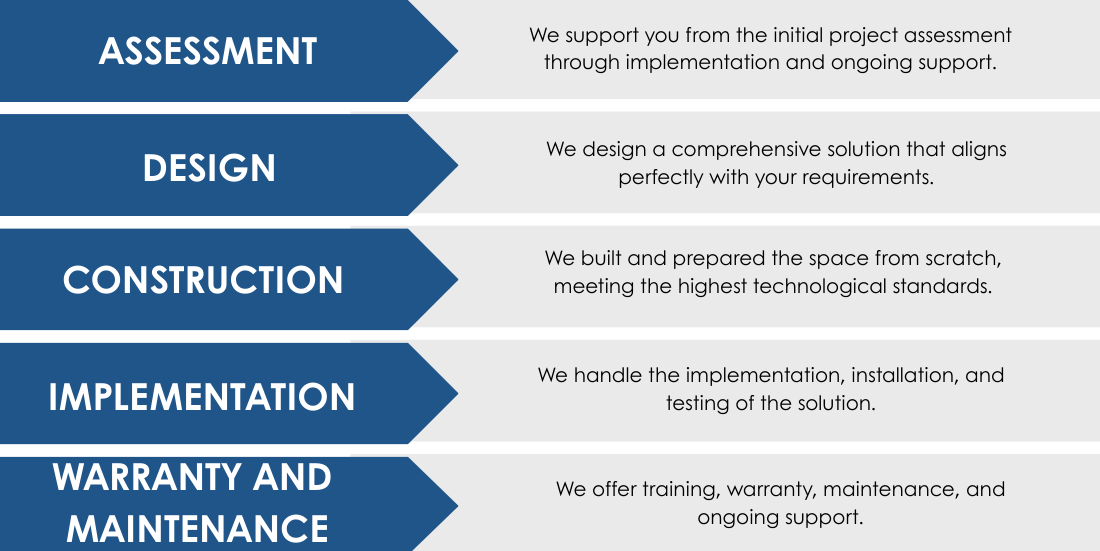
Design, implementation, and optimization
A traditional data center remains the preferred choice for organizations seeking full customization, direct access, and physical isolation of their information.
NDC Solutions designs each data center based on three core pillars: 1) Energy efficiency (improved PUE), 2) Structural and physical security, 3) Electrical and communications redundancy.
Our team coordinates everything from space architecture to systems integration, ensuring compliance with TIA-942, ISO 27001, and ANSI standards.
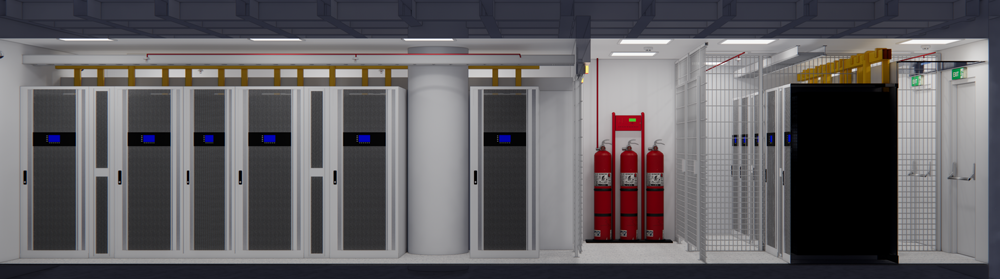
Benefits of choosing a traditional data center
-
-
-
Total control:
Direct oversight of the entire infrastructure.
-
High customization:
Design tailored to business needs.
-
Superior physical security:
Dedicated spaces with restricted access.
-
Guaranteed redundancy:
Ability to operate 24/7 during power or network failures.
-
Complete technology integration:
Compatible with DCIM, SCADA, and BMS systems.
-
Long-term stability:
A solid investment with continuous and predictable returns.
-
-















Frequently asked questions about traditional data centers
A micro data center is compact and designed for decentralized locations or low workloads.
A traditional data center is a larger infrastructure aimed at high processing volumes.
While a micro data center can be installed in days, a traditional data center offers greater capacity, redundancy, and lifespan, making it ideal for companies with mission-critical operations.
Security is addressed on three levels:
- Physical: biometric access, 24/7 video surveillance, secure aisles.
- Environmental: humidity and temperature control, and fire detection.
- Operational: remote monitoring, intrusion alarms, and contingency protocols.
NDC Solutions integrates all these layers into a cohesive environment certified under international standards.
The cost depends on size, level of redundancy, and equipment. In general, it ranges between US$7,000 and US$12,000 per m², including cooling, security, and power.
However, unlike a modular data center, the traditional model involves civil construction and ongoing maintenance, which can result in higher long-term operating costs.
Yes. More and more companies are adopting hybrid architectures, combining traditional infrastructure with prefabricated modules or cloud storage.
This approach helps optimize costs and ensure redundancy. For example, the traditional data center hosts critical systems, while modules are used for temporary expansion or testing new applications.
Artificial intelligence, edge computing, and automation have transformed data center management.
Current trends include:
- Integration with Answer Engine Optimization (AEO) tools for greater visibility of technical systems.
- Use of AI for predictive maintenance.
- IoT sensors that monitor humidity, airflow, and security in real time.
- Adoption of liquid cooling for high-performance GPUs.
The traditional data center is evolving into an intelligent infrastructure without losing its core strengths: total control, stability, and security.
A traditional data center is physically built from the ground up within an existing facility, providing greater customization, control, and isolation.
A modular data center, on the other hand, is prefabricated and can be deployed much faster.
Organizations that require mission-critical environments or handle sensitive information often choose the traditional model for its full independence, while the modular option offers better scalability and a lower initial cost.
Preventive maintenance is key:
- Quarterly inspection of UPS systems and batteries.
- Cleaning of filters and verification of airflow.
- Updates to DCIM and BMS software.
- Annual CFD simulations to validate thermal performance.
At NDC Solutions, we combine predictive maintenance with real-time data analysis to reduce failures and unplanned downtime.
It includes double-conversion UPS systems, backup generators, redundant batteries, and intelligent power distribution panels. These systems ensure continuous and stable power. NDC Solutions designs 2N or N+1 topologies based on the client’s level of criticality, in compliance with Uptime Institute Tier II–IV standards.
Despite the rise of modular and cloud solutions, many sectors such as banking, defense, and healthcare, require full control over their infrastructure.
A traditional data center makes it possible to:
- Keep data within the organization’s own facilities.
- Comply with privacy and security regulations.
- Integrate proprietary IT systems.
- Implement tailored power and cooling redundancy.
This makes it a strategic investment for mission-critical operations.