



CFD analysis
Intelligent thermal efficiency. Optimize the thermal and energy performance of your data center with precise, professional CFD simulations. Visualize, predict, and resolve issues before they impact operations.





CFD simulation is the most powerful tool for anticipating failures, optimizing efficiency, and protecting the operational continuity of your data center
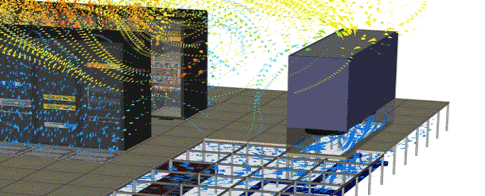
CFD (Computational Fluid Dynamics) simulation makes it possible to mathematically model the behavior of airflow, temperature, and pressure within a data center. Through advanced numerical methods and specialized algorithms, it enables detailed visualization of hot and cold airflows, identification of hot spots, anticipation of contingency risks, and the design of improvements that reduce energy consumption.
In an environment where every rack, aisle, and cooling unit directly impacts system stability, CFD analysis becomes a strategic tool. It not only reveals how your infrastructure behaves today, but also how it will respond to growth scenarios, failures, environmental changes, or future expansions.
Efficient airflow
It analyzes the movement of cold and hot air between racks, aisles, and cooling units to ensure proper and stable distribution.

Full visibility
It provides a detailed view of the data center under normal operating conditions and contingency scenarios, enabling confident decision-making.
Optimized infrastructure
It helps align the data center design with actual thermal demands and plan expansions efficiently.
Energy efficiency
It evaluates the effectiveness of the cooling system, identifies inefficiencies, and reduces electrical consumption through precise configurations.
CFD analysis transforms invisible data into intelligent decisions to maximize efficiency and protect your critical infrastructure.
Through advanced simulations, it is possible to study the thermal gradient across the entire space, measure the effectiveness of cooling units, identify hot spots, and optimize the data center configuration. CFD technology also makes it possible to simulate future scenarios, such as increased loads, equipment failures, or expansions, helping to plan investments strategically.
Having a virtual representation of environmental behavior reduces risk, accelerates decision-making, and enables operations with greater stability, reliability, and energy efficiency.
Failure prevention
It enables anticipation of hot spots, excessive energy consumption, and hidden risks, ensuring system stability and operational continuity.
Thermal control
It analyzes the complete thermal gradient and optimizes cooling unit settings to achieve maximum performance.
Intelligent design
It facilitates data center planning and improvement, allowing capacity projection and evaluation of configurations without risk.
Continuous optimization
It simulates alternative scenarios, compares configurations, and proposes continuous improvements without the need to interrupt operations.
NDC Solutions CFD Analysis
-
-
-
Greater efficiency
CFD simulation reveals energy-saving opportunities and maximizes cooling capacity without oversizing equipment.
-
Operational continuity
Identifies risks and potential failures, ensuring stability, reduced downtime, and safe environments for critical equipment.
-
Technical decision-making
Provides accurate data to justify investments, reconfigurations, or upgrades based on real and simulated data.
-
Design validation
Allows evaluation of existing or new designs before implementation in physical infrastructure.
-
True scalability
Projects how the data center will perform under future loads, enabling strategic planning with confidence.
-
Cost reduction
Minimizes operating expenses, avoids costly errors, and improves overall efficiency by optimizing thermal and airflow systems.
-
-
















Frequently asked questions about CFD analysis
Yes. In a micro data center, CFD is even more critical, as compact spaces accumulate heat rapidly.
Modeling thermal airflow helps properly size cooling systems, select optimal fan placement, and maintain quiet, stable operation, even in non-industrial environments.
It reduces the carbon footprint by lowering energy consumption in HVAC systems. It optimizes the use of cold air and minimizes the release of hot air into the environment.
Additionally, by keeping equipment within ideal thermal ranges, it reduces the need for premature replacements, lowering electronic waste.
CFD supports corporate sustainability initiatives aligned with the Sustainable Development Goals (SDGs).
We recommend performing it:
- Before building a new data center.
- Whenever the infrastructure is expanded or reconfigured.
- Annually, to verify that thermal efficiency is maintained.
CFD is not just a design tool, but a continuous improvement process that keeps the infrastructure aligned with business growth.
Companies that implement CFD report:
- Up to 30% lower electricity consumption for cooling.
- 20% longer lifespan for critical equipment.
- ROI within 6 to 9 months, according to Uptime Institute data (2024).
In addition, by preventing overheating or outages, operational and reputational losses are reduced.
CFD turns thermal design into a strategy for cost savings and sustainability.
CFD analysis, or Computational Fluid Dynamics analysis, allows simulation of airflow, heat, and pressure within a data center to improve thermal efficiency.
Using specialized software, three-dimensional models of the data center are created to show how air circulates and how equipment dissipates heat.
This helps optimize the physical layout and cooling system, reducing energy consumption and preventing hot spots that could compromise availability.
Without CFD, data center design is based on estimates. This can lead to:
- Undetected hot zones.
- Higher energy consumption.
- Risk of thermal shutdowns.
- Shorter lifecycles for critical hardware.
In contrast, CFD helps prevent these issues, optimize resources, and ensure continuous, efficient operation.
It delivers data on:
- Temperatures and thermal gradients.
- Air pressure and directional airflow.
- Energy consumption and HVAC performance.
- Hot spot prediction.
This information is presented in 3D visualizations and allows hypothetical simulations, such as rack changes or fan failures, without impacting the real environment.
CFD analyzes physical conditions such as airflow, heat, and thermal behavior, while DCIM monitors and manages the infrastructure in real time.
Both complement each other: CFD optimizes the design, and DCIM validates day-to-day performance. Together, they form the foundation of an intelligent data center, especially when integrated with AI and predictive monitoring.
We use professional tools such as 6SigmaDCX, ANSYS Fluent, and Autodesk CFD, along with proprietary models developed in-house.
This allows us to simulate customized scenarios for each client.
We also integrate the results with monitoring platforms such as DCIM or BMS, so recommendations can be automatically applied to the operational environment.
Today’s modular and traditional data centers handle increasingly high thermal densities. Without CFD analysis, airflow can become inefficient and lead to overheating.
With CFD, engineers can visualize thermal distribution, optimize hot and cold aisle configurations, and prevent costly failures. In fact, ASHRAE 2024 studies indicate that data centers using CFD simulations achieve up to 28% energy savings.