


Let’s start by defining Delta T (ΔT).
Delta is commonly used in mathematics and physics to denote a difference or change in something. For example, Δx = x2 – x1 or Δt = t2 – t1. In other words, Delta T is the temperature differential that exists between two points.
In the data center, we can find four clearly defined Delta Ts; let’s look at the figure below:

- Delta T1 (ΔT1) = The temperature differential between the air entering the cooling unit and the air leaving it.
- Delta T2 (ΔT2) = The temperature differential between the air leaving the cooling unit and the air entering the servers or IT equipment.
- Delta T3 (ΔT3) = The temperature differential between the air entering the servers or IT equipment and the air leaving them.
- Delta T4 (ΔT4) = The temperature differential between the air leaving the servers or IT equipment and the air entering the cooling unit.
Optimal Values for the Different Delta Ts
One of the most critical values for maximizing cooling unit performance is what we have designated as Delta T1 (ΔT1), whose optimal range is between 9 °C and 12 °C (16 °F and 22 °F). Generally, a high Delta T indicates deficient airflow, whereas a low Delta T indicates poor performance of the cooling system.
Here is the mathematical formula establishing the relationship between airflow and Delta T:
ΔT = 3.1W ÷ CFM
where
3.1 = constant coefficient at sea level.
W = Watts.
CFM = Airflow in cubic feet per minute.
The ideal values for Delta T2 (ΔT2) and Delta T4 (ΔT4) are as close to zero as possible.
The value for Delta T3 (ΔT3) is typically around 10 °C to 15 °C (20 °F to 30 °F).
So far, we have seen the ideal values for each one. The question is: how do we keep these Delta Ts at their ideal values?
There are many variables to consider, the most important being cold and/or hot aisle containment. Choosing one, the other, or both must be evaluated to determine the optimal configuration for each data center.
Let’s look at an example of a Data Center without aisle containment:
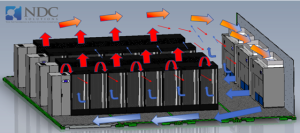
By the second law of thermodynamics, cold air from the cooling units mixes with hot air exiting the servers or IT equipment. In this example, we encounter many of the common issues that typically affect a data center:
Air recirculation.
A very low Delta T value, indicating poor cooling unit performance and higher energy consumption.
Potential hotspots.
Temperature fluctuations at the server or IT equipment air intakes.
Now let’s view this example through a CFD (Computational Fluid Dynamics) analysis:
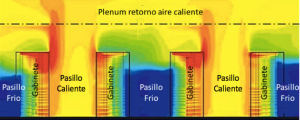
The solution is to install cold and/or hot aisle containment as needed to ensure air streams of different temperatures do not mix, thereby improving the various Delta T values. This results in optimal cooling unit performance and more efficient energy use across the Data Center.
Let’s look at the case using hot aisle containment with a ceiling plenum and ducted cabinets for hot air return:
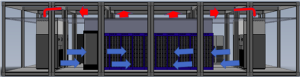
From a CFD analysis:
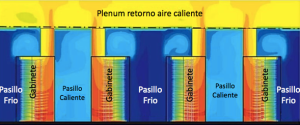
In this case, we observe the separation of different air streams based on temperature. This guarantees that the air entering the servers is appropriate and, more importantly, free of temperature fluctuations.
Another advantage of this configuration is the elimination of potential hotspots and avoiding exceeding cooling capacity—you use exactly what is required.
We also see that Delta T2 and Delta T4 values approach zero.
Based on industry best practices, the GSA (US General Services Administration) states that energy savings between 4% and 5% can be achieved for every 0.56 °C (1 °F) increase in server intake air temperature.
Furthermore, according to ASHRAE (American Society of Heating, Refrigerating and Air-Conditioning Engineers), the maximum allowable temperature can reach up to 27 °C (80.6 °F). By utilizing these aisle containment strategies, it is possible to safely operate the data center at higher temperatures.
Additional recommendations to complement your cold/hot aisle containment strategy and boost data center efficiency:
Use blanking panels in cabinets to prevent empty rack spaces.
Use LED lighting.
Where possible, choose white cabinets.
Ensure there are no cold or hot air leaks anywhere.
Power down unused servers and IT equipment.
Additional note: When using cold aisle containment, ensure that the fire suppression agent can reach all areas of the data center. Also, keep in mind that hot aisle temperatures can become uncomfortable for technicians and operators working in the data center, requiring appropriate safety precautions.
For more information, contact us at https://www.ndc-solutions.com or email us at info@ndc-solutions.com. We also invite you to visit us on our social media channels.