



Modular data center
We design intelligent infrastructures that evolve with you. A modular data center delivers flexibility, energy efficiency, and full control over your IT operations. Fast, secure, and scalable solutions that prepare your organization for the digital future.


Modular data center: Intelligent and scalable infrastructure
A modular data center is a data center infrastructure built using prefabricated components that are assembled as individual modules. This modular architecture allows capacity to be expanded without disrupting operations, offering a practical alternative to costly traditional builds.
CIOs and IT leaders choose this model because it solves three key challenges: growth, energy efficiency, and operational continuity. At NDC Solutions, we integrate monitoring, power, cooling, and security into a single controlled environment, ready to support mission-critical workloads and on-demand expansion.
Integrated systems in a modular data center

System monitoring
The intelligent monitoring system fully communicates with UPS, cooling, power, and all types of sensors, providing real-time data at all times.

Security systems
An enclosed rack with in-row cooling, modular UPS, and continuous monitoring ensures thermal stability and energy efficiency.

Cooling systems
Multiple types of cooling solutions can be deployed in a site-adapted configuration, removing heat and creating the optimal environment for your data center.

Energy systems
The modular, rack-mounted UPS (uninterruptible power supply) system delivers high-quality power and protects IT equipment from poor power conditions and outages.
Containment systems
The containment and rack system provides a secure space for installing IT equipment and managing cabling.
Fire suppression systems
The room-mounted fire suppression system automatically detects fire conditions and releases the integrated FM200/Novec 1230 gas to extinguish the fire.
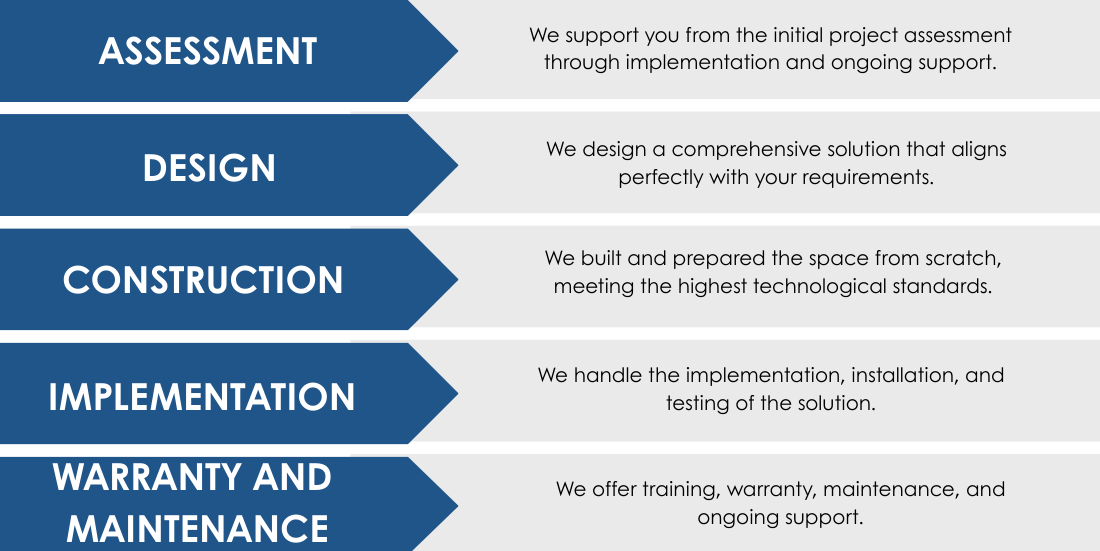
Process
Modular data center models
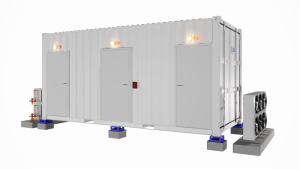
Modular, based on modules or ISO containers
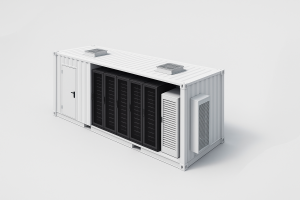
It is an infrastructure solution that integrates all the components of a traditional data center, engineered to withstand harsh environments such as rain, snow, and hail. Additionally, being built to ISO standards, it can be easily loaded onto trucks, ships, and transported along highways and roads in any country.
Custom-built modular solution
Designed with an interactive modular architecture, this data center enables seamless infrastructure scaling based on real-time demand. By deploying only the required components at each phase, we optimize capital expenditure and directly align your investment with operational priorities.
Indoor modular data center solutions
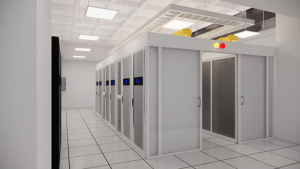
Built using factory-fabricated modular components assembled inside existing structures like warehouses or offices, this data center speeds up time-to-market and reduces deployment costs while offering pay-as-you-grow flexibility for future IT capacity.
Benefits of choosing a modular data center
-
-
-
Immediate scalability:
Expand your infrastructure without interruptions.
-
Rapid deployment:
Up to 70% faster than traditional construction.
-
Energy efficiency:
Optimize consumption and reduce operating costs.
-
Advanced security:
Full integration of monitoring and physical access control.
-
Installation flexibility:
Adaptable for outdoor or indoor environments.
-
AI-ready:
Compatible with next-generation workloads and process automation.
-
-














Frequently asked questions about modular data centers
Yes. Modular units are fully compatible with DCIM, SCADA, and BMS software. They communicate via SNMP or Modbus-TCP protocols, enabling unified monitoring of power, temperature, access, and performance.
This makes the modular data center an intelligent solution that seamlessly integrates into an organization’s existing technology ecosystem.
For technology leaders, the primary value lies in adaptability and budget control. A CIO can start with a 50 kW unit and scale it as demand grows. In addition, tools such as CFD analysis allow airflow and energy consumption to be simulated before expanding the infrastructure.
This reduces the risk of overinvestment and enables data-driven decision-making—essential in the era of artificial intelligence and predictive analytics.
It depends on size and complexity, but typically between 30 and 90 days. The prefabricated structure and integrated systems (power, cooling, monitoring) allow for rapid installation. For larger projects, timelines can extend up to 120 days when integration with external systems such as DCIM or BMS is required.
Yes. Each module includes fire detection and automatic suppression using FM200 or Novec 1230 gas. In addition, modular UPS systems ensure continuous power supply even during electrical outages.
These systems comply with ISO and TIA-942 standards, providing Tier II to Tier IV resilience, depending on the selected configuration.
The differences are significant:
- Lower upfront cost: Built in modules, avoiding large one-time capital investments.
- Faster deployment: 30 to 90 days versus 6 to 12 months.
- Energy efficiency: Sealed designs that reduce thermal losses.
- Flexibility: Can be installed indoors or outdoors.
- Simplified maintenance: Integrated monitoring and remote diagnostics.
In summary, the modular model delivers the same performance as a traditional data center, but with greater agility and a lower total cost of ownership.
A modular data center is a prefabricated facility made up of interconnected modules that house servers, electrical systems, cooling, and monitoring. Unlike traditional data centers, this model allows for progressive expansion without major civil works or operational downtime.
CIOs choose this approach because it reduces deployment timelines, simplifies hardware lifecycle management, and provides greater energy control. In addition, its compact design makes maintenance easier and enables deployment in remote locations or sites with space constraints.
A modular data center is designed for medium to large operations with continuous scalability. In contrast, a micro data center is compact and typically used for specific workloads or remote locations.
Both can coexist: a micro data center can operate as a node or extension of the modular data center, enabling data decentralization and greater operational flexibility.
The rise of artificial intelligence, edge computing, and IoT is driving strong demand for modular data centers. Their rapid deployment and compatibility with high-density GPU workloads position them as a foundation of the digital future.
In fact, according to Gartner (2025), 70% of new enterprise data centers are expected to adopt a modular or hybrid approach before 2030.
At NDC Solutions, we are bringing that future forward—helping organizations evolve toward infrastructures built for AI, automation, and global scalability.
Very little. Its sealed and controlled design minimizes dust, humidity, and overheating-related failures. Integrated monitoring systems enable remote diagnostics and generate alerts before issues occur. At NDC Solutions, we offer AI-driven predictive maintenance, ensuring higher availability and extended equipment lifespan.